


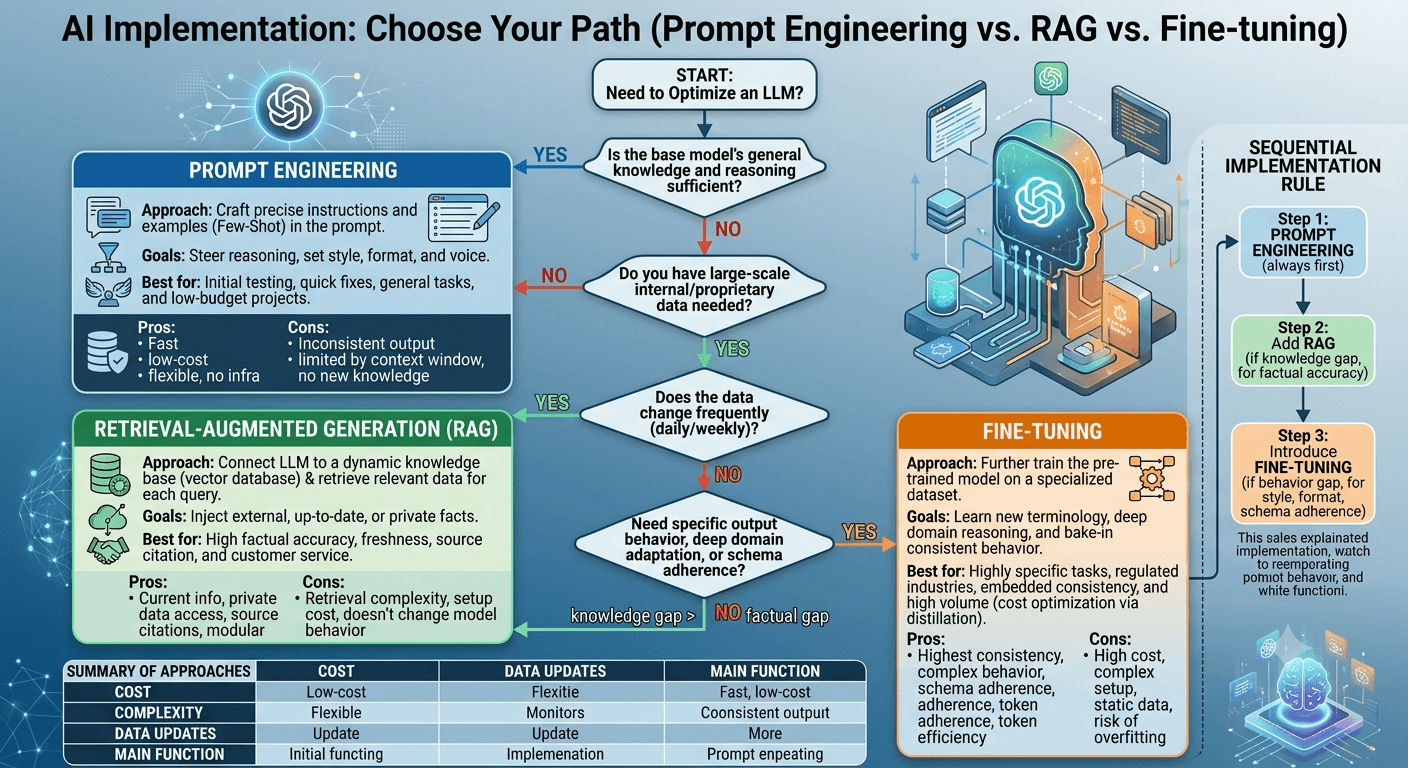
The short answer: start with prompt engineering, add retrieval if the model needs your specific data, and reach for fine-tuning only when both of those have been genuinely exhausted — because fine-tuning is the most expensive, slowest-to-iterate option of the three, and most business problems never actually need it.
Fine-tuning vs prompt engineering: which does your AI project actually need?
What each approach actually does
Prompt engineering shapes the model's behavior through instructions, examples, and structure in the input — no training involved, changes take effect immediately, and it's nearly free to iterate on. Retrieval-augmented generation (RAG) gives the model access to your specific documents or data at query time, so it can answer from your knowledge base rather than its training data. Fine-tuning actually retrains the model's weights on your examples, changing how it behaves at a fundamental level rather than just what information it has access to.
Why most projects should start with prompting
Prompt engineering is fast to test, fast to iterate, and costs nothing beyond engineering time — you can validate an approach in an afternoon and revise it in minutes when it's not working. Because iteration is nearly free, it's always the right starting point, even for problems that might eventually need something more. Teams that jump straight to fine-tuning without first exhausting prompting and retrieval routinely discover, months later, that a well-structured prompt would have solved the problem for a fraction of the cost and time.
When retrieval solves the actual problem
If the model's failures are about missing information — it doesn't know your product catalog, your policies, your documents — retrieval solves that without touching the model's underlying behavior at all. This is the right layer for "the model doesn't know X" problems, and it's dramatically cheaper to build and maintain than fine-tuning, with the added benefit that updating your knowledge base doesn't require retraining anything.
When fine-tuning is actually the right call
Fine-tuning earns its cost in specific situations: when you need a consistent, specialized output format or style that prompting can't reliably enforce across thousands of variations, when you need the model to reliably follow complex domain-specific reasoning patterns that are hard to fully specify in a prompt, or when you're running high enough volume that a smaller fine-tuned model can replace an expensive frontier model for a narrow task and the savings justify the fine-tuning investment. Fine-tuning is a behavior change, not a knowledge change — it doesn't teach the model new facts efficiently, which is what retrieval is for.
The cost and maintenance reality
Fine-tuning requires a quality training dataset (often harder to produce than expected), compute cost for the training process itself, and ongoing maintenance — when the underlying base model updates or your requirements shift, you may need to retrain. This connects directly to the cost drivers we cover in what AI implementation actually costs: fine-tuning is rarely the first place budget should go, because prompting and retrieval solve the majority of real business problems at a fraction of the investment.
A practical decision sequence
Try prompt engineering first, with real test cases, not just a few manual checks. If the failures are knowledge gaps, add retrieval. If failures persist and are about consistency of behavior or format rather than missing information, and the volume justifies the investment, consider fine-tuning — evaluated with the same rigor described in our framework for testing AI agents, since a fine-tuned model needs regression testing just as much as a prompted one.
If you're not sure which layer your project actually needs, that diagnosis is exactly what we do before scoping any build — our AI development team starts every engagement by identifying the cheapest approach that solves the real problem, not the most sophisticated one available.
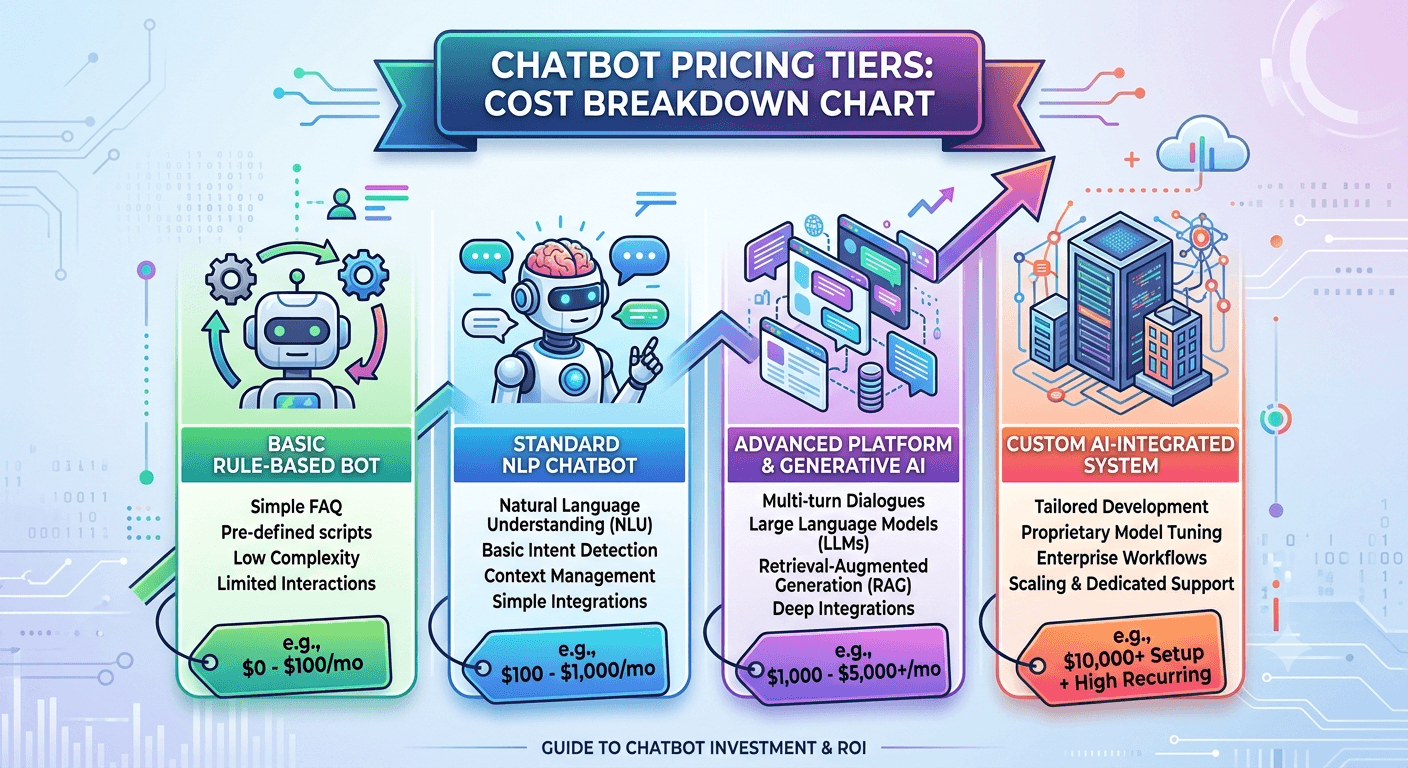
How Much Does a Custom Chatbot Cost? | Electronikmedia
How to choose a QA outsourcing partner (the questions that actually matter)
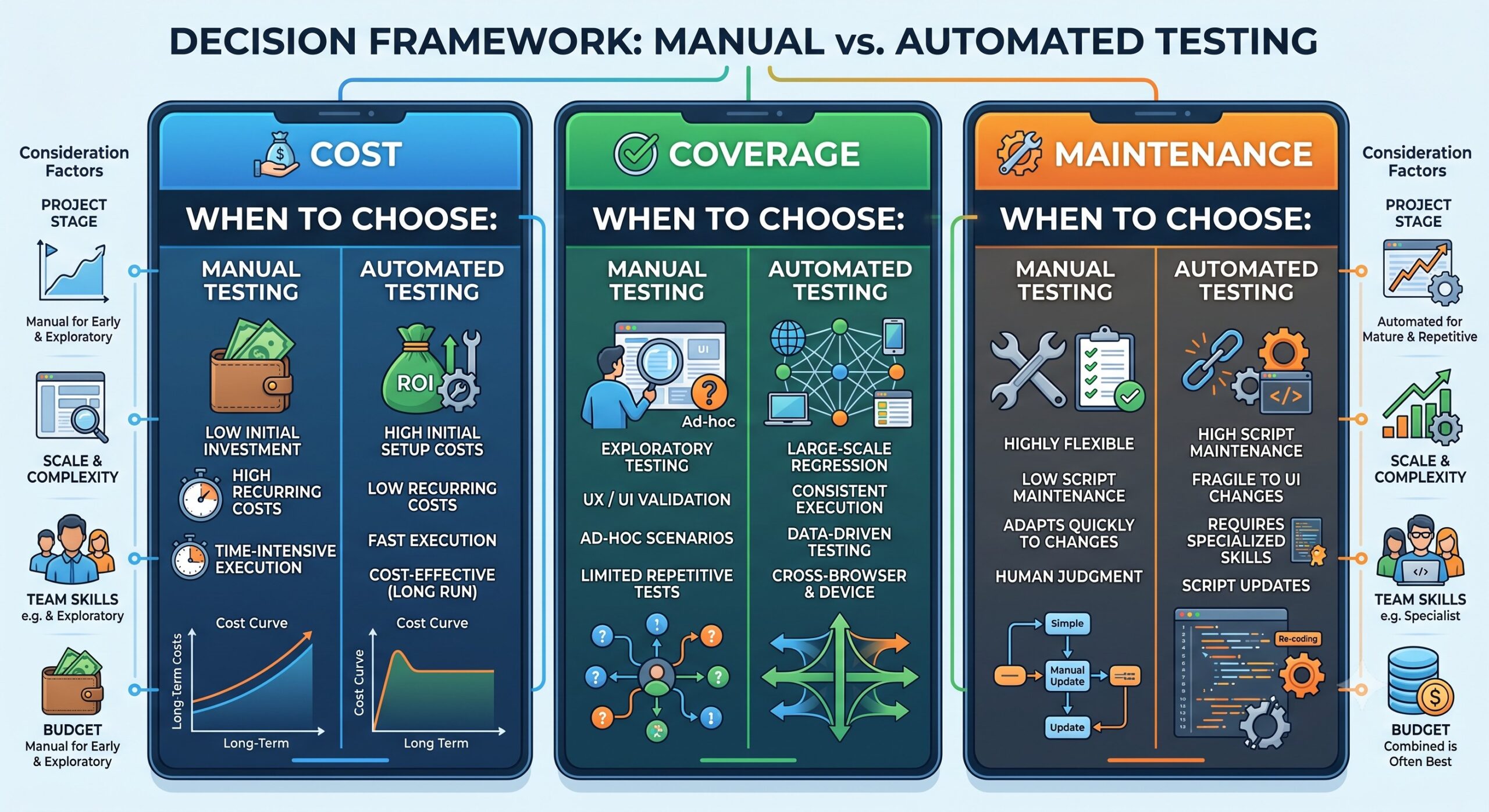
Manual vs automated testing: which does your project actually need?
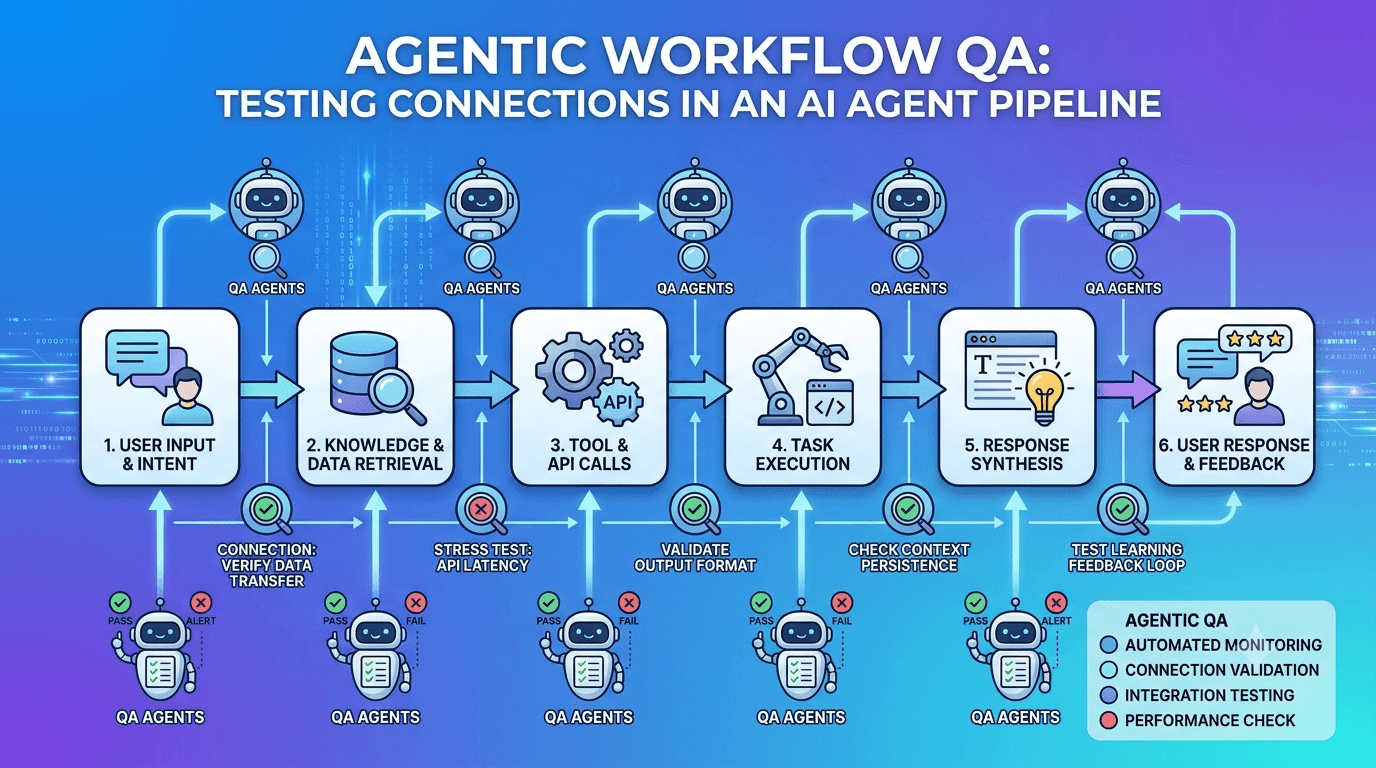
What is agentic workflow QA (and why it’s different from testing a chatbot)
