


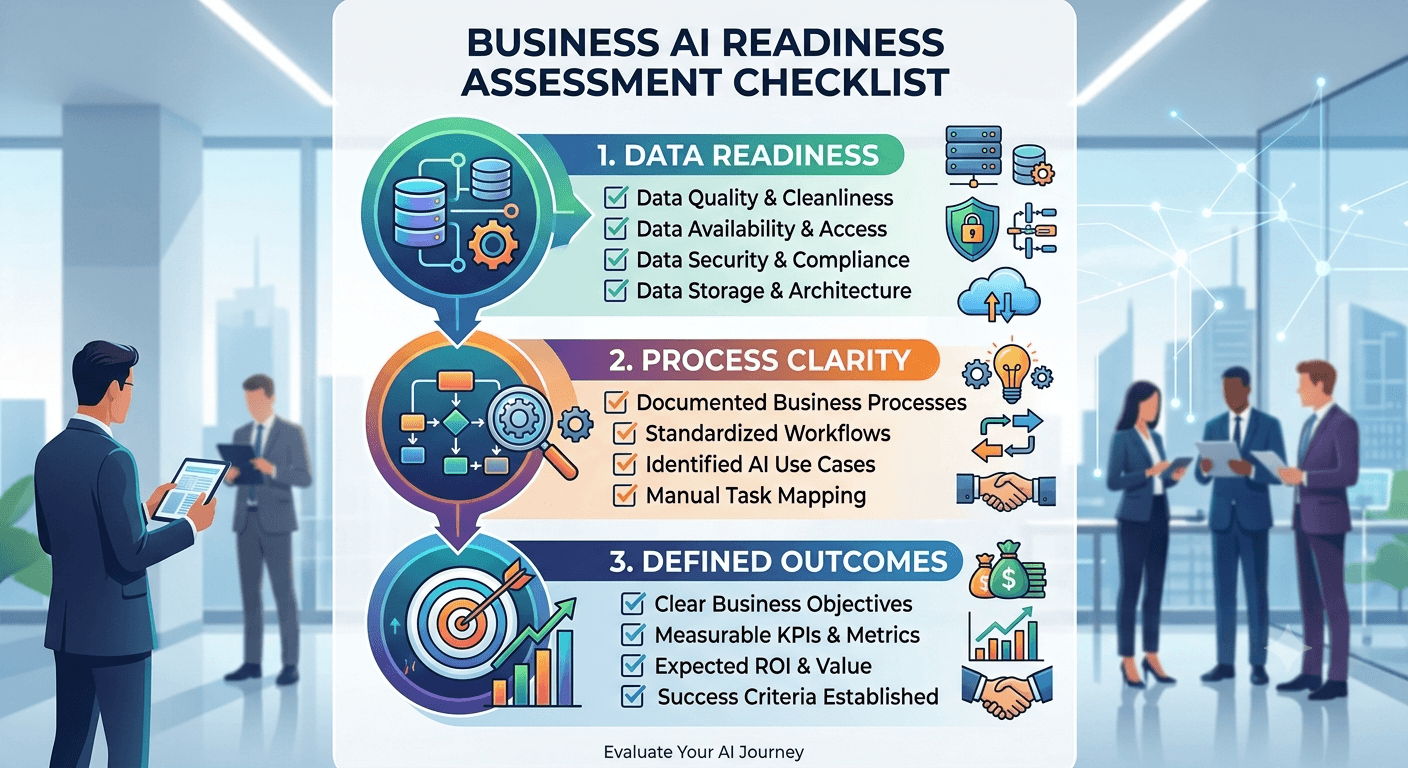
The short answer: your business is ready for AI when you have a specific, well-defined problem worth solving, access to the data that problem requires, and internal clarity on what success looks like — not when you've adopted enough other technology or reached some notion of "digital maturity." Readiness is about the problem and the data, not the size or sophistication of your existing tech stack.
How do I know if my business is ready for AI?
The readiness myth worth dismissing
Many companies delay AI projects believing they need modern infrastructure, a data science team, or a broader digital transformation completed first. In practice, some of the most successful AI implementations happen at companies with fairly ordinary existing systems — because the actual requirement isn't infrastructure sophistication, it's a clear problem and accessible data relevant to that problem. Waiting for a nebulous "readiness" milestone that isn't well defined usually just delays value that could start now.
Checkpoint 1: Do you have a specific problem, not a general aspiration
"We want to use AI" is not a project; "we want to reduce the time our support team spends on routine ticket triage" is. The difference matters enormously — a specific problem can be scoped, measured, and solved; a general aspiration cannot. If your starting point is closer to the first than the second, the actual next step is problem definition, not a technology evaluation, which is exactly the immersion work covered in our forward-deployed AI engineers approach — finding the specific problem before building anything.
Checkpoint 2: Is the data the problem requires actually accessible
AI systems need data relevant to the specific problem — historical examples, documents, records — and that data needs to be reachable, not necessarily perfect. It's a myth that data needs to be pristine before starting; it's not a myth that the data needs to exist and be gettable. If the information central to your problem lives in someone's head or an unstructured pile of documents nobody's organized, that's addressable, but it changes the scope and cost of the project, a factor covered in what AI implementation actually costs.
Checkpoint 3: Can you define what success looks like, concretely
"Better customer service" isn't measurable. "Reduce average first-response time by 30%" is. Projects that can't articulate a measurable definition of success before starting struggle to know if they've succeeded once built, and struggle even more to get organizational buy-in for the next phase. If your team can't yet answer "what does Monday morning look like differently if this works," that conversation needs to happen before development does.
Checkpoint 4: Is there an owner who can make decisions
AI projects need someone with the authority to make scoping tradeoffs, approve changes to how a process works, and champion the project internally when early results are imperfect (which they usually are, initially). A project with no clear owner tends to stall at the first ambiguous decision point, regardless of how ready the technology or data actually was.
What "not ready yet" actually looks like
The honest signals that a business isn't ready yet: no one internally can articulate a specific problem worth solving, the relevant data genuinely doesn't exist anywhere accessible, or there's no organizational appetite to change any process based on what the AI recommends — meaning even a technically successful system wouldn't get used. These are real blockers worth addressing first; a modest existing tech stack is not.
The practical takeaway
Readiness is about problem clarity and data access, not technology sophistication — which means more businesses are ready to start than assume they are. If you're unsure whether your situation clears these checkpoints, that assessment itself is a reasonable starting engagement — our AI development team and forward-deployed engineers both start here, because an honest readiness conversation upfront is what makes everything that follows actually work.
How much does software testing cost?
What features should a small business actually look for in a website chatbot?
How do I know if my website needs a redesign?
How does a website chatbot help small businesses get more leads?
