


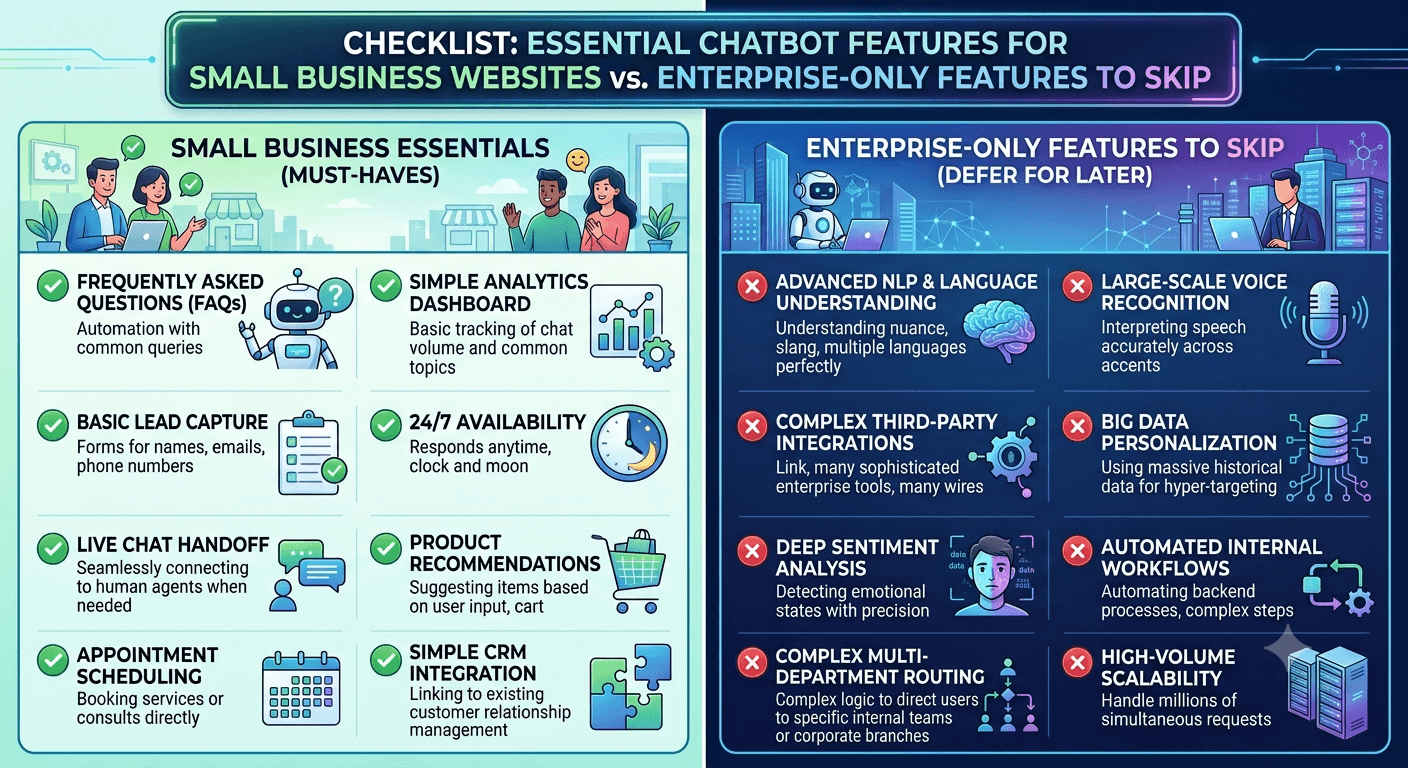
The short answer: prioritize natural, accurate answers to your real customer questions, simple lead capture and handoff to a human, and easy setup and maintenance — and deprioritize the long enterprise feature lists (multi-language support for markets you don't serve, complex workflow builders, extensive third-party integrations) that add cost without adding value for most small business use cases.
What features should a small business actually look for in a website chatbot?
Why most chatbot feature comparisons don't fit SME needs
Many chatbot vendors market toward enterprise buyers, and their feature lists reflect that: dozens of integrations, complex analytics dashboards, and configuration options built for teams with a dedicated person to manage them. A small business doesn't need most of this — it needs a chatbot that answers real customer questions accurately, captures interest cleanly, and doesn't require ongoing technical maintenance from someone who doesn't have time for it.
The features that genuinely matter for an SME chatbot
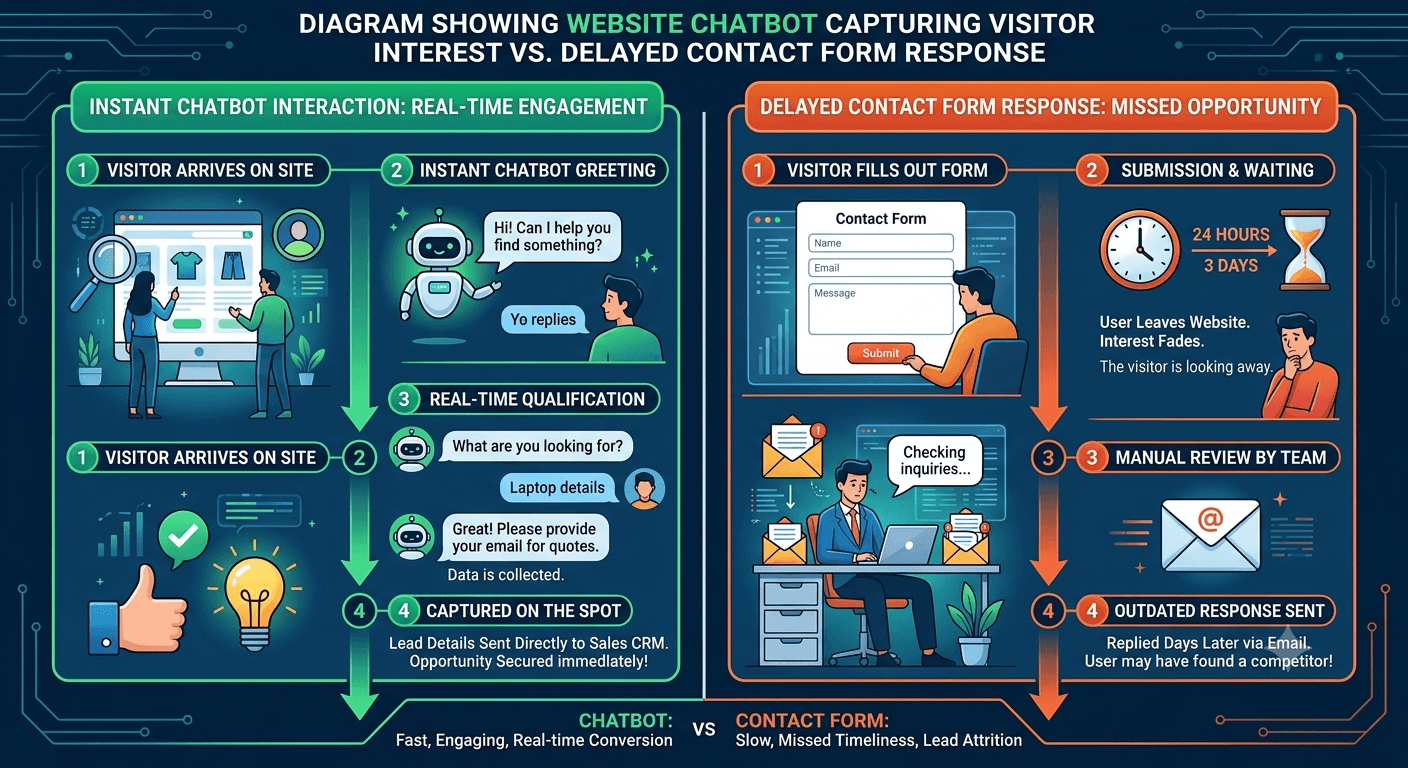
Accurate answers grounded in your actual business information — pricing, hours, services, policies — rather than generic responses that sound plausible but are wrong for your specific business. This matters more than almost anything else: a chatbot that confidently gives incorrect information does more damage than no chatbot at all. Clean handoff to a human — the chatbot should recognize when a question is beyond what it can answer and make it easy to reach a real person, rather than trapping visitors in an unhelpful loop. Simple lead capture — collecting a name, contact detail, and the essence of what someone needs, formatted so your team can act on it immediately rather than digging through a transcript. Easy setup without ongoing technical burden — a small business needs to update its hours, pricing, or a policy without filing a support ticket or waiting on a developer every time something changes. Reasonable, predictable pricing — costs that scale sensibly with your actual traffic and usage, not enterprise pricing structures built for a different scale of business.
Features to deprioritize for most small businesses
Extensive multi-language support if your business genuinely operates in one language and market — a nice-to-have that adds cost without adding value if it's not solving a real need you have. Complex workflow builders meant for building elaborate multi-step automated sequences — most SME use cases are simpler than these tools are built for, and the complexity becomes overhead rather than value. A long list of third-party integrations you'll never actually connect — evaluate integrations based on the two or three systems you genuinely use, not a feature checklist of everything the platform supports.
The question that cuts through most feature comparisons
For each feature on a vendor's list, ask: does this solve a real problem I currently have, or does it just sound impressive? Most SME chatbot needs are genuinely simple — answer real questions accurately, capture the lead, hand off cleanly — and a chatbot built around that simplicity, done well, outperforms an over-featured one that's harder to maintain and configure correctly.
The practical takeaway
The right chatbot for a small business is the one built around your actual customer questions and your actual capacity to maintain it — not the one with the longest feature list. Our chatbot development team builds SME chatbots around exactly this principle: solving your real, specific needs well, rather than shipping a generic enterprise tool scaled down.
How do I know if my business is ready for AI?
How much does software testing cost?
How do I know if my website needs a redesign?
How does a website chatbot help small businesses get more leads?
